Happiness, Like Opening Your Eyes to See Other Bright, Kind Fishes Swimming Alongside You. #amwriting

You know how sometimes you’re moseying through your life, teaching classes, reading great books, tending to the family, house, groceries, and pets, writing each morning before work (like you promised yourself you would, yay), and then someone says something nice to you out of the blue like, “You’re pretty,” or “You told me something wise in high school that stuck with me,” or whatever it is, and suddenly life feels more sparkly? There’s a shift. The current changes, and you feel as if you’re not swimming upstream anymore, or maybe your eyes are open wider to see the other bright, kind fishes swimming alongside you.

Three things happened this week that made me feel that kind of happiness, and they all have to do with writing since that is my life’s ambition and mostly what I blog about here. 🙂

  1. Melanie Noell Bernard invited me to post a guest blog in a special series she’s running in January. I really love Melanie’s blog, and it’s an honor to be asked. (I hope I don’t let her down.)
  2. My first reblog–thank you, Elizabeth Huff of the Well-Rounded Writer.
  3. A writer I crossed paths with during NaNoWriMo 2015 messaged me through the NaNo site (it’s crazy that I decided to check my message box there six days after the event ended) saying he “liked my style” in the WIP excerpts I posted in the forums and asked to be a beta reader for my novel. Wow, someone WANTS to read my book.

It’s been a good week.

–Eve Messenger


Vanishing Girls and Good Advice

Embedded image permalink

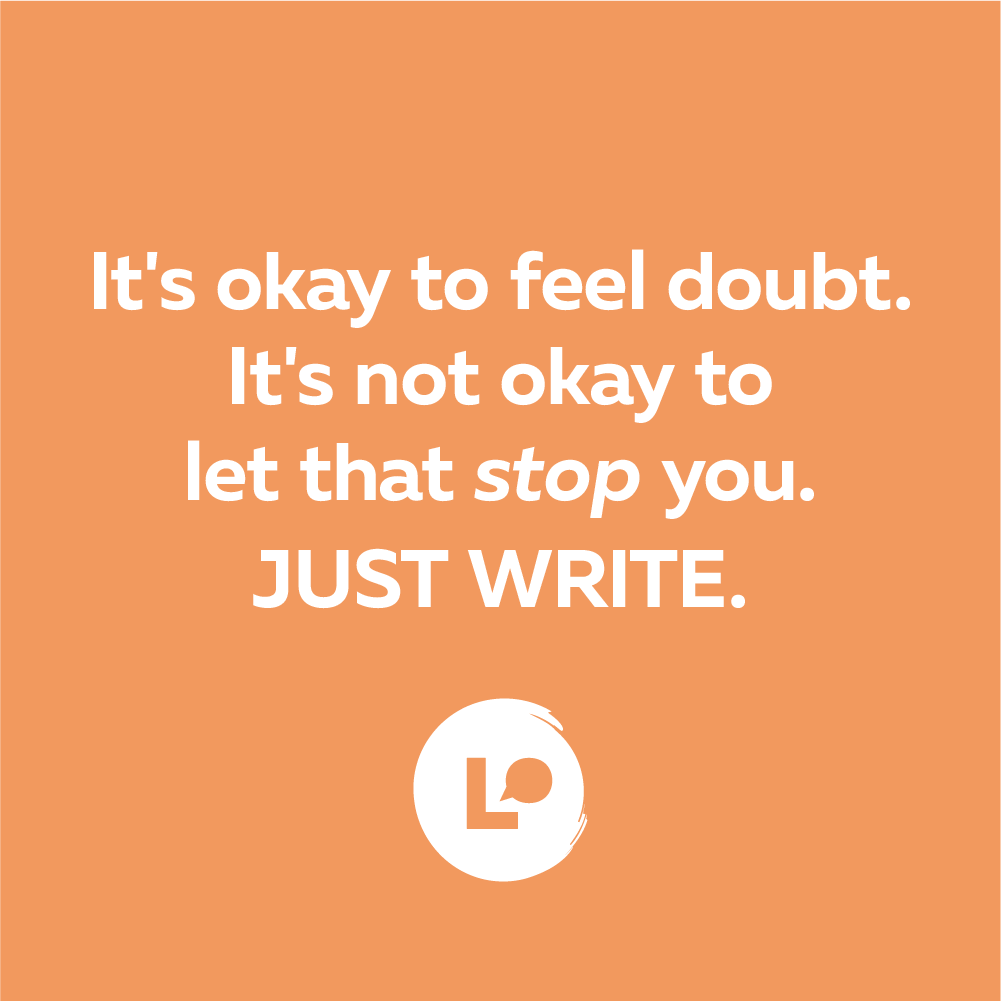
Thank you, Lauren Oliver, for posting this on Twitter today. With twelve excellent published novels under her belt, Lauren knows what she’s talking about. I will write and not let doubt stand in my way!

Another thing: I just finished reading Lauren Oliver’s Vanishing Girls, a novel that blew my mind. It’s difficult to properly review Vanishing Girls without giving away spoilers, so I’ll just say it’s not what you expect, and you will feel compelled to re-read the story. Trust me.

— Eve Messenger

That Which You Fear Most, Face First

I feel this overwhelming resistance to working on my current novel. Once I start writing (which I still do, every day), the words flow, but for the past couple of days sitting down to write feels like forcing myself through quicksand. I want to understand why so I can overcome it.

Could it be because choosing to write–or not to write–is something within my control, while other things feel pretty out of control right now?

Or maybe I’m feeling unworthy of writing this particular story.  I want to write a story that’s as good as the fantasy novels I’ve loved, and I’m stunted by that thought perhaps.

When creating a first draft, I usually let the story flow the way it wants to, and I don’t read back through it until the second draft stage. However, today I wanted to post a line from my work in progress on Twitter for #1lineWed (one-line Wednesday), when writers from all over tweet a line or two from their manuscripts in response to a weekly theme, this week’s theme being “action.”

As I skimmed through my YA fantasy novel for an action line, I found myself really liking much of what I’d written so far. Did this encourage me? Maybe a little, but like a cranky toddler I’m still resistant to returning to write more.

As I struggle through these feelings, I have to remind myself of a kind of epiphany I had after many years of young adult procrastination–like forgetting to pay my car registration then getting pulled over for expired tags, and other self-sabotaging attempts to control things by NOT doing them. Here’s the saying I try to live by: That which you fear most, face first.

When I started doing this, my life became less chaotic and much more livable. I still stumble. For instance, I have a major project to complete at work, which I’ve been putting off for, um, weeks now, so today have to go in to work–on Veterans Day holiday–to complete (okay, START)  the project.  The stakes are high, the work must get done, so I just need to face it.

About writing, the irony is that when I give myself permission to NOT write, I still do it because there’s nothing else I’d rather do. And whatever the writing crisis might be, the advice I always get from established writers is: WRITE THROUGH IT.

So now I’m off to complete that project at work. And I’ll also put in more work on my new novel. Yes, I’ll probably have to force myself to sit at my desk and get started, but eventually the writing resistance will pass– as it always has before.

–Eve Messenger

What is Your “Moment?”

Many successful people actively visualize their life’s ambitions. Over and over, they imagine a specific moment that captures the essence of what they’d like to accomplish.

Before he made it big as an actor/comedian, Jim Carey used to drive to the top of Mulholland Drive, look out on the sparkling lights of Hollywood, and visualize himself receiving  a million-dollar check for his acting work. Professional quarterback Drew Brees, before winning his first Superbowl, saw himself walking out onto the playing field.

What is your “moment?” Here’s mine.

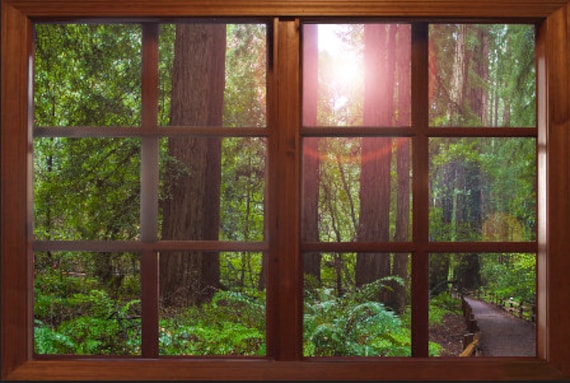
Invigorated by a long walk and at peace with how well my family is doing, I sit in my lovely office with forest light cascading through the window.

Copies of my published novels rest on a shelf.

My literary agent emails to say my latest book has gone to auction and that another has been optioned for a movie.

My imagination swirls with scenes, dialogue, and characters’ intentions for the new novel I’m writing.

Then I write, and the words flow beautifully.

Strange How One of the Best Talks Can Come at 4:30 a.m. in an Emergency Room

Strange how, in the course of our busy lives, one of the best talks can come at 4:30 a.m. in an emergency room with machines beeping and nurses conversing in the hall.

3:12 a.m. My husband stands specter-like beside our bed, shocking me awake with, “I need to go to the hospital.”

The hospital (where our daughter was born) is a three-minute drive from our home, so I drive.

3:14 a.m. At the emergency room, my husband is a man experiencing chest pain; there is no wait.

3:18 a.m. Once we’re in the examining room a nurse–handsome, calm, good-natured–asks, “Pain level from one to ten?”

“Ten.”

Tests.

Embarrassment as a huge team of student doctors surrounds my husband’s bed with questions and conjecturing.

More tests.

My husband is wise and smart; he tells excellent stories; and, so far, he is not dying.

4:30 a.m. Morphine drip. My husband relaxes into its relief and enchantment while I, seated on a chair with my head resting on his bed’s side rail, float in a woken-in-the-middle of the night half-dream

We nerd out on Game of Thrones.

“How could Maester Aemon have access to milk of the poppies in Castle Black?”

“George R. R. Martin is a genius.”

Then…

“Remember when we first met in the writers’ workshop at UCI?”

“You used to wear a cowboy hat.”

“You were good at stroking the instructor’s ego.”

In the daily crush of earning a living, raising a family, and Keeping It Together, we rarely have the time–or take the time–to say how proud we are of one another, which makes me feel all the more grateful for what my husband says next.

“I’m proud of you for pursuing your writing dream,” he says, “You’re doing everything right. You will get there. There’s just one more important thing you have to do…” This is where my husband, master storyteller that he is, closes his eyes for effect and employs his trademark dramatic pause. At last, he says, “Don’t quit.”

I look at him and love him and memorize this moment. And I commit his words to memory.

Don’t quit.

— Eve Messenger

P.S. My husband is fine.

Reading While Writing – Is it a Bad Thing?

NTSNBN

There’s this YA dystopian thriller I’ve been dying to read.  Very hyped, mentioned in lots of blogs, highly ranked on Goodreads. I won’t mention the title because — call me superstitious, or maybe respectful or polite — I won’t publicly write negative things about another writer’s published work. Who knows, maybe you’ll guess it from the references I’m about to make. Anyway, I was excited to read this book, but I stopped myself.  I stopped myself from reading any fiction.  Why? Because I’ve heard from other writers that reading while you write can be detrimental.

But reading is the shizzle!

So two days ago I picked up this hyped novel-that-shall-not-be-named (henceforth known as NTSNBN), and I began to read.   Even though I’m working on my own novel.

And it’s been really helpful!  Possibly because NTSNBN is in a different enough genre from my own YA fantasy adventure. Or maybe because it’s a good book but not so brilliant that I’m utterly intimidated. Or maybe (and probably most significantly) because the plot and characters of my own novel are well-formed enough that reading someone else’s novel — both as a positive and negative example — gives me ideas on how to enhance what I already have.

Back when I was tapping and scribbling out the nucleus of a plot in coffee houses, libraries, and all the other free places writers and homeless people hang out, reading someone else’s novel might have been detrimental to my process. Consciously or subconsciously, another writer’s plots and characters could have crept their way into my own writing.   (Though I probably will take the chance and try it while writing the next novel.)

After two days of reading NTSNBN — while working on the 2nd/3rd major revision of my own — here’s how reading someone else’s novel has been beneficial. Throughout the narrative, NTSNBN gives a very clear sense of the main character’s emotional state. It contains too much a lot of internal self-talk. With a keener awareness of this, the next time I sat down to work on my own book, my characters started spilling their emotional guts a lot more.

I like that.

The author of NTSNBN also employs several quirky stylistic devices, such as replacing number words with the alphanumeric, as in ‘2’ instead of ‘two.’  Also, there are long passages that deliberately avoid commas. Thirdly, there is a lot lot lot of  too much  striking out of lines and words, which signify the MC censoring his/her own thoughts.   Though I probably won’t use those devices in my own writing, the stylistic experiments definitely inspire me to try new things.

Lastly, NTSNBN reads really fast. All the chapters flow really well, each with its own grabber that takes you right into the heart of the scene and an ending that propels you further into the story. All wonderful things to keep in mind while revising and polishing my own work.

E.B.M.

Books Choose Their Authors

Michelangelo's

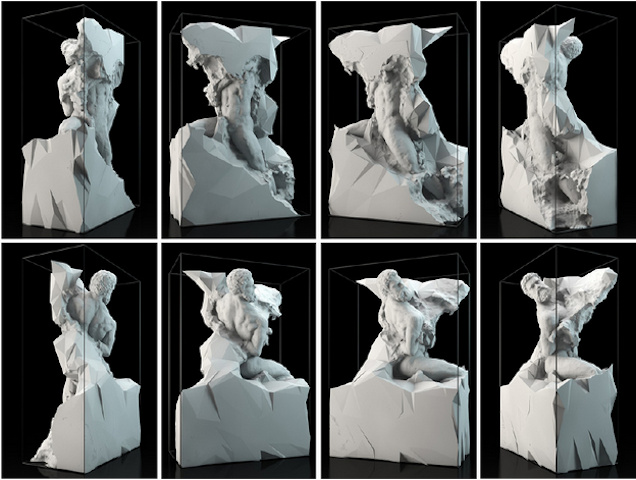
Michelangelo said, “Every block of stone has a statue inside it, and it is the task of the sculptor to discover it.” Salman Rushdie said, “Books choose their authors.” This concept of a complete work of art waiting in the ethos to be carefully released by the artist, helps me. I find it reassuring to think of my novel not as an evolving thing but as something which exists and is merely waiting to be discovered. With each editing and writing session, I chisel away at the marble to expose the True Work within.

As I move well into the first revision of my YA fantasy novel, do I see the True Work revealing itself? Yes, the characters, the magic, the plot twists, the history, they’re all very exciting to discover. But the thing I can’t seem to reveal — the thing that is kicking my excavating arse, quite frankly — is the most important element of all: what the main character truly, truly wants. She wants a lot of things. She wants to buck convention; she is very curious and wants to know where the massive structures on her otherwise bucolic world come from, who built them, what their purpose is or was. She questions the True Mission of her people and wants to turn against it. I’m having a hard time solidifying that into EXACTLY what she wants. I get this feeling that the answer is right in front of me but I’m not seeing it.

Fellow Writer, What Puts You into a Creative State of Mind? 

Creativity

I’d be really curious to learn what stirs your imagination and creative spirit.  If it’s music, do you usually listen to the same music, or does the music vary depending on what you’re creating?  Reading great literature?  Exercise — rigorous workouts or leisurely strolls?  Habit, as in writing at the same time every day or in a particular environment?  Meditation?  Random things?

I’d love to hear from you!